
Free vs Paid Transaction Acceleration: The Real Trade-Off
Free acceleration is defined by two conditions, not by goodwill: a transaction of 0.5 KB or smaller, submitted at a fee rate of at least 0.0001 BTC/KB. Anything above that size, or below that rate, has to go down the paid path — where the cost is deducted in BTC, BCH or LTC and the submission cannot be cancelled or refunded. The real trade-off is not free versus paid; it is waiting versus paying for time.

Key takeaways
- The free tier has a size ceiling and a fee-rate floor: 0.5 KB or smaller at 0.0001 BTC/KB or higher, with the free quota refreshed hourly and processed in submission order.
- A 0.5 KB transaction at the minimum qualifying rate pays about 0.00005 BTC in network fees — roughly $4.23 at a $84,692 BTC price — so the free window is narrow by design.
- Paid acceleration is settled in BTC, BCH or LTC from account assets, and it is irreversible: once submitted, the transaction cannot be cancelled and the fee is not refunded.
- Acceleration does not fix a broken transaction: double-spend attempts are not supported, and a transaction spending unconfirmed inputs cannot be accelerated — send the parent transaction first.
The core idea
Confirmations are bought with block space, and block space is priced by fee rate per kilobyte. A transaction that pays below the going rate does not fail; it waits. Acceleration is the mechanism that moves a waiting transaction into the next block a particular pool mines, which is why the service is offered by a mining pool rather than by a wallet.
ViaBTC runs the two-tier version of this. The free submission path accepts transactions of 0.5 KB or smaller with a fee rate of at least 0.0001 BTC/KB, refreshes its free quota hourly and processes submissions in the order they arrive. The paid path takes transactions that fall outside those limits, bills the fee in BTC, BCH or LTC from the account, and gives the transaction priority packing in the pool's next mined block.[1]
Two mechanics decide what that is worth. First, submission order within the free tier means the queue is a queue: a transaction landing after the hourly quota is exhausted waits for the next window. Second, priority packing is a property of one pool's blocks, not of the whole network, so the expected gain is measured in blocks rather than in guarantees.
| Question | Free submission | Paid acceleration |
|---|---|---|
| Who qualifies | Transaction ≤ 0.5 KB with fee rate ≥ 0.0001 BTC/KB | Transactions outside the free limits |
| Cost model | No service fee; the network fee rate floor still applies | Paid in BTC, BCH or LTC, deducted from account assets |
| Queue behaviour | Free quota refreshes hourly, processed in submission order | Priority packing in the next block the pool mines |
| Reversibility | Submit again in a later window if the transaction still waits | Cannot be cancelled after submission and is not refunded |
| Hard limits | Larger or lower-rate transactions are rejected | No double-spend support; unconfirmed inputs block acceleration |
The practical reading is that the free tier is a scheduling service and the paid tier is a priority service. One rearranges your transaction within a queue you cannot see; the other buys position at a price quoted when you submit. Both do the same thing to your wallet — they shorten the interval between a transaction being broadcast and being spendable.
How it plays out at scale
For a miner, the interval matters more than the transaction, because mining revenue arrives as a stream of small amounts that only becomes useful money once it moves on-chain. On the pool side, PPS+ settles the block-reward component per share with a listed 4% fee and pays hourly against current difficulty, while the transaction-fee component follows PPLNS logic at a listed 2%; mining payouts themselves carry no fee.[2]
Concretely, a 1 PH/s position accrues about 0.000449 BTC a day at 132.76 T difficulty, which is roughly 0.0000187 BTC — about $1.58 — every hour. Paid hourly, that balance is available to withdraw or convert long before the electricity invoice ever arrives.
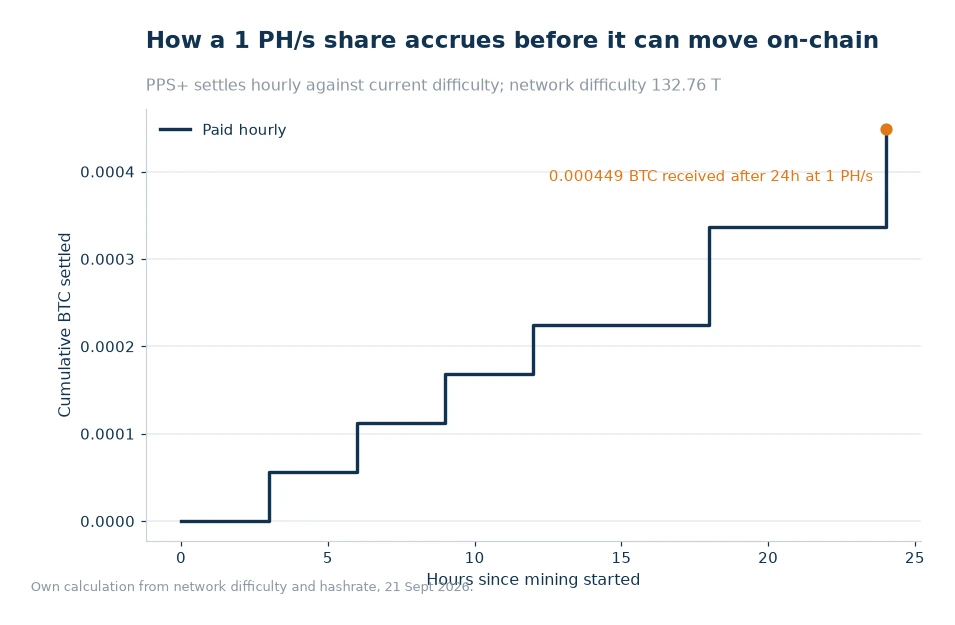
The stream creates a second-order exposure that has nothing to do with mining. Once you decide to move that balance, the transfer competes for block space like any other transaction, and a balance in transit is a balance that cannot pay a supplier. That is the cost the paid tier prices: not the fee itself, but the hours or days between broadcast and confirmation, multiplied by whatever the money was supposed to do.
This is also where a multi-currency wallet in the same account as the mining dashboard changes the arithmetic. If balances, conversion and withdrawals sit beside the mining stats, the number of on-chain steps between earned BTC and spendable money goes down — and every step you remove is a transaction that no longer needs accelerating at all.
Two scenarios compared
Scenario one: the miner's withdrawal. A miner withdraws 0.01 BTC after a good month. The transaction is 0.4 KB and pays 0.00012 BTC/KB, which clears both free conditions, so it goes in free, ahead of nothing in particular, and waits for the hourly window and its turn in the queue. Nothing was paid for that position, and the only cost is time.
Scenario two: the same withdrawal, submitted differently. The same transfer at 0.6 KB with a rate of 0.00008 BTC/KB fails both free conditions — it is too large and it pays too little. The paid path is the only option, the fee is quoted in BTC, BCH or LTC from the account, and the transaction enters the next block the pool mines. Note what is being bought: not a guarantee about the whole network, but priority in blocks this pool produces, and only for a transaction whose inputs are already confirmed.[3]
The comparison is not "free versus expensive", because the free submission carries a hidden cost of its own: it consumes a free slot that refreshes only hourly. Send three transactions in five minutes and the third may wait a full window behind two others. Miners who move balances frequently often find that consolidating transfers — fewer, larger movements instead of many small ones — removes more delay than any acceleration tier can buy.
Where acceleration already pays for itself is the case it was built for: a single transaction that has to land now. The published free conditions give you a threshold to check before submitting — 0.5 KB at 0.0001 BTC/KB — and the paid path exists for everything above it. A mining pool dashboard that shows settlement timing per worker is the other half of that decision: it tells you when the balance will be ready to move, so the acceleration request is sent once, instead of three times while guessing.
For miners who want the mechanism behind the fee split rather than the transaction itself, an account at a ViaBTC TX Accelerator-enabled pool keeps earnings, wallet and the acceleration tool in one login — which matters when the alternative is exporting keys or moving funds to a third-party service just to get a pending transfer mined.
Common failure modes
- Submitting a transaction with unconfirmed inputs. The accelerator cannot help, because the parent transaction has not confirmed yet. Accelerate the earlier transaction first, then the child.
- Treating the free tier as an unlimited queue. The quota refreshes hourly and submissions are processed in order, so a burst of transactions can push the last one past the current window.
- Expecting a refund. Paid submissions cannot be cancelled after they are sent and the fee is not returned — including when the transaction confirms faster than you feared it would.
- Using it on a double-spend attempt. Unsupported, and it is the fastest way to lose the fee without moving the transaction.
- Accelerating instead of restructuring. Five small withdrawals will always cost more attention than one larger transfer; the tool changes priority, not the number of transactions you create.
Frequently asked questions
How often should a miner check pool statistics?
Weekly is enough for cash flow, daily if you are reconciling worker uptime or chasing a hashrate fault.
Does the payout method change my average income?
It changes the variance and the fee, not the underlying expected value: your share of network hashrate still sets the ceiling.
How large a transaction can be accelerated for free?
0.5 KB or smaller, and only if the fee rate is at least 0.0001 BTC/KB. Both conditions must hold; a transaction that misses either one needs the paid path.
Can the same transaction be submitted twice?
Resubmitting to the free path in a later hourly window is possible while the transaction is still unconfirmed. Once a paid submission has been sent, it cannot be cancelled and the fee is not refunded, so there is nothing to reuse.
Check the two thresholds, then decide
Measure the transaction size and its fee rate before you choose a path, because those two numbers decide whether you have a choice at all. If it qualifies, file it in the free queue early in the hourly window and let time do the work. If it does not, treat the paid fee as the price of moving money today and confirm that the settlement timing justifies it. Either way, fewer and larger transfers beat a well-tuned accelerator used three times a week.
Data and sources: ViaBTC transaction accelerator documentation[1], ViaBTC pricing and payment-method documentation[2] and the pool's published fee breakdown[3]. Network difficulty of 132.76 T, 1,003,107,267,295 GH/s of network hashrate and a $84,692 BTC price were read on 21 September 2026. Fee thresholds are as published at that date and are illustrative of the arithmetic only.